Pagesmith.ai
P
  • Features
  • Pricing
  • Blog
  • Documentation
  • Contact
Start Building
Pagesmith.ai
P

From idea to stunning website in minutes. Just describe it, we'll build it.

All rights reserved.

Company
  • About Us
About
  • Blog
  • Contact
Product
  • Documentation
Legal
  • Terms of Service
  • Privacy Policy
  • Cookie Policy
Dec 18, 2025

The Ugly Truth About Vibe Coding: Why Your AI Website is Invisible to Google

Most CSR-first AI website builders struggle with SEO by design. Learn why architecture matters more than prompts, and how SSG delivers crawlable HTML that actually ranks.

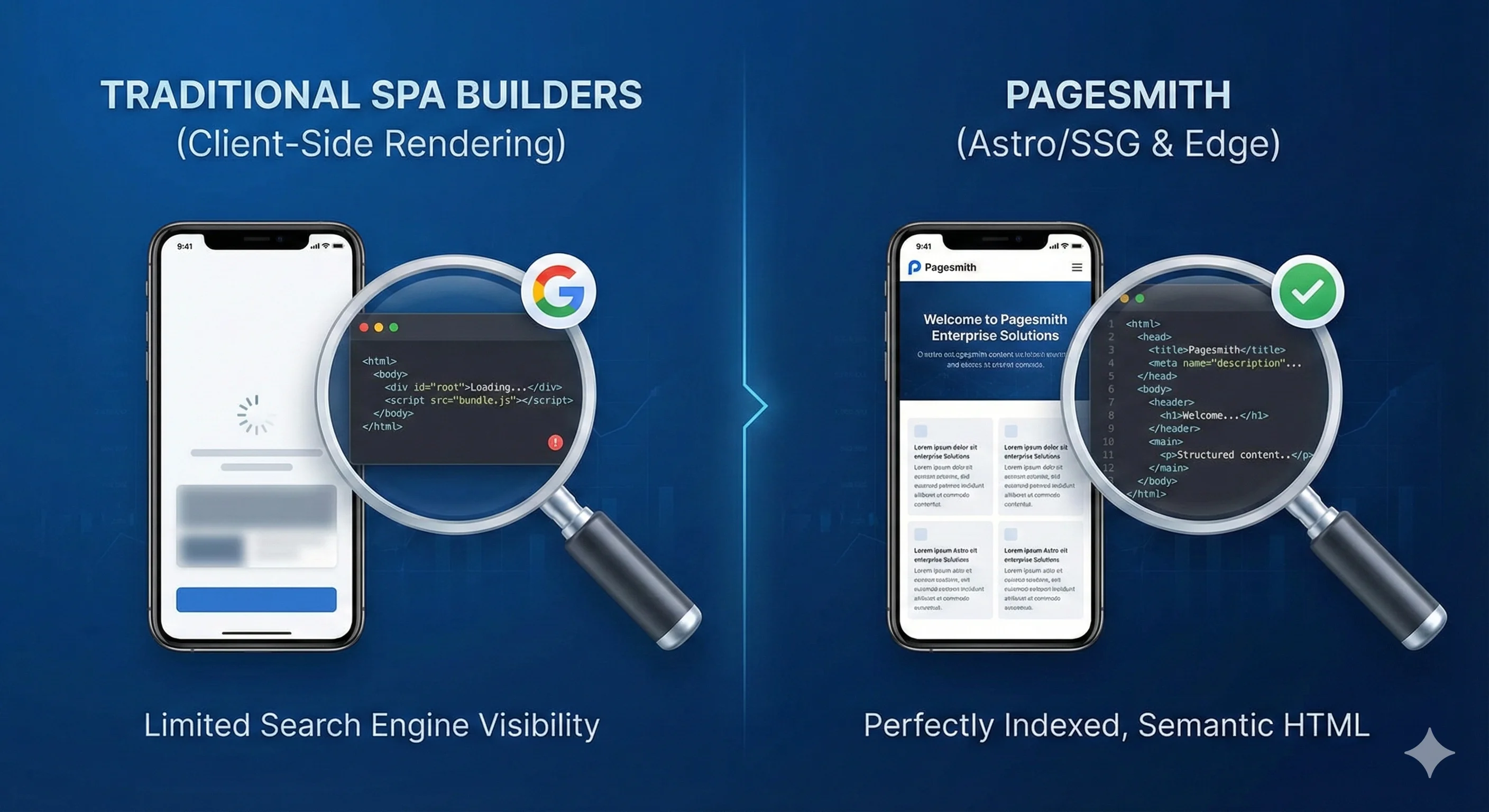
Cover Image for The Ugly Truth About Vibe Coding: Why Your AI Website is Invisible to Google

The rise of AI website builders has been nothing short of a revolution. Tools like Lovable have made it incredibly easy to "vibe code" beautiful UIs and functional apps in minutes.

But there's an uncomfortable truth in the AI web building world that doesn't get discussed enough: most CSR-first builders are creating websites that struggle to get indexed.

If you're building a SaaS dashboard or an internal tool, this doesn't matter. But if you're building a marketing site, a directory, or a blog intended to rank on Google, the architecture of your builder matters more than the prompt you used to create it.

Here's the technical reality of why SSG-first platforms like Pagesmith have a structural advantage for SEO, and why this isn't something that can be fixed with better prompting.

The "White Screen" Problem: CSR vs. SSG

To understand the difference, you have to look at the code.

How CSR-First Builders Work

Most AI website builders, including popular tools like Lovable, create Single Page Applications (SPAs) using React. During the initial crawl, search engine bots often see something like this:

<body>
  <div id="root"></div>
  <script src="/assets/index.js"></script>
</body>

The actual content only appears after a JavaScript bundle downloads and executes. While Google can render JavaScript, indexing is often delayed or inconsistent—depending on your site's crawl budget and domain authority.

How SSG-First Builders Work

Pagesmith takes a different approach. We default to Static Site Generation (SSG) or Server-Side Rendering (SSR) using modern frameworks like Astro. When a crawler visits a Pagesmith site, it sees:

<body>
  <h1>The Best AI Website Builder</h1>
  <p>Pagesmith generates clean, semantic HTML...</p>
</body>

Your content is there immediately. It's readable by every crawler, social media bot, and AI agent (like ChatGPT or Perplexity) on the first request.

đź’ˇ

The Core Difference

CSR serves an empty shell that JavaScript fills in. SSG serves complete HTML that's immediately readable. Search engines and AI assistants strongly prefer the latter.

The SEO Comparison at a Glance

TL;DR: Across indexing speed, performance, social previews, and operational cost, SSG consistently wins for content that needs to be discovered.

FactorCSR-First (e.g., Lovable)SSG-First (Pagesmith)
Initial HTMLEmpty <div>Full content
Google indexingDelayed or inconsistentImmediate
PageSpeed scoreVaries90-100
Social media previewsOften brokenRich cards
AI assistant visibilityInconsistentFully visible
JavaScript requiredYesNo
Time to first content2-5 secondsUnder 1 second
Sitemap accuracyManual/error-proneAuto-generated
Meta tagsRequires workaroundsBuilt-in
Pre-render service neededOften yes ($9-50/mo)No

The pattern is clear: if discoverability matters, architecture matters.

Why Prompting Can't Fix Architecture

If you browse Reddit or Discord, you'll see users claiming they found a "magic prompt" to fix SEO issues in CSR-first builders.

Unfortunately, this isn't how it works.

You can't prompt an AI to change the fundamental build architecture of a platform. CSR-first tools are designed to output React SPAs. No matter how you phrase your request for "SEO-friendly output," the underlying architecture remains the same.

If you try to manually modify the code to force SSR, you often break the visual editor—defeating the purpose of using an AI builder in the first place.

📝

This isn't a criticism of these tools. It's simply a recognition that they were optimized for different use cases—interactive apps, not discoverable websites.

The Hidden Cost of Workarounds

Because of these architectural constraints, an ecosystem of workarounds has emerged. Services like Prerender.io exist to add a pre-rendering layer on top of SPA sites.

These services work by creating a "pre-rendering proxy"—a middleman that generates static snapshots for crawlers.

But this introduces tradeoffs:

  • Cost: Another monthly subscription ($9–$50/month) to make your site indexable.
  • Complexity: You're now managing DNS records and middleware proxies.
  • Latency: It adds another network hop.

With an SSG-first approach, you get crawlable HTML out of the box. No extra subscriptions. No proxies.

Sitemaps That Actually Work

Another common issue with general-purpose AI coding tools is sitemap accuracy. When you ask an LLM to "generate a sitemap," it may hallucinate pages that don't exist or miss pages you've recently added.

Pagesmith handles technical SEO programmatically:

  • Automatic Sitemaps: Generated from your actual file structure. No hallucinations.
  • Meta Tags & Schema: Structured data is built in, not bolted on.
  • Performance: SSG sites typically score 95-100 on PageSpeed Insights by default.

Core Web Vitals: Why Architecture Matters for Performance

Google measures how fast your site loads through Core Web Vitals—a confirmed ranking factor.

The Three Metrics That Matter

  • Largest Contentful Paint (LCP): Time until main content is visible. CSR sites must download and execute JavaScript first. SSG sites show content immediately.
  • First Input Delay (FID): Time until the page responds to interaction. Heavy JavaScript bundles can block the main thread.
  • Cumulative Layout Shift (CLS): How much the page moves while loading. CSR sites can experience layout shifts during hydration.

SSG architecture naturally excels at these metrics because there's no JavaScript execution blocking the initial render. Pagesmith sites typically score 90-100 on PageSpeed Insights by default.

âś…

Test It Yourself

Run any SSG site through PageSpeed Insights and compare it to a JavaScript-heavy SPA. The performance difference is usually dramatic.

The Social Media Preview Problem

Here's something most people don't think about until it's too late: what happens when someone shares your site on Twitter, LinkedIn, or Slack?

Social platforms send crawlers to fetch Open Graph meta tags. These crawlers typically don't execute JavaScript—they see the raw HTML.

For CSR sites, this often means:

  • No title preview
  • No description
  • No image
  • Just a bare URL

For SSG sites, every share displays a rich preview card, because the meta tags are in the HTML from the start.

AI Discovery: The New SEO Frontier

Google is no longer the only discovery channel. Millions of people now search using AI assistants like ChatGPT, Perplexity, Claude, and Google's AI Overviews.

These AI systems often:

  • Have stricter timeouts for JavaScript execution
  • Prioritize clean, semantic HTML
  • Favor sites with clear content hierarchy
  • Index content based on initial page load

If your content requires JavaScript to render, AI assistants may not see it consistently. Server-rendered sites have an advantage in AI-driven discovery.

⚠️

The AI Discovery Shift

As more users search through AI assistants instead of Google, JavaScript-dependent sites face an even bigger visibility gap. AI crawlers are less forgiving than Googlebot.

Google's Two-Wave Indexing

Google uses what's effectively a two-wave indexing system:

Wave 1: Google crawls your URL and indexes the raw HTML immediately.

Wave 2: Pages requiring JavaScript rendering enter a separate queue. Depending on your site's authority and Google's crawl budget, this can take days, weeks, or may not happen reliably.

For new sites without established authority, JavaScript-dependent content may experience significant indexing delays.

With SSG, there is no Wave 2. Your content is indexed in Wave 1.

The Compounding Advantage of Starting Right

A common mindset is: "I'll migrate to an SEO-friendly platform later when traffic matters."

Here's why starting with the right foundation compounds over time:

  1. Domain authority accumulates: Every month of crawlable content builds your site's authority. Starting on SSG means you're accumulating from day one.

  2. URLs are investments: Backlinks, social shares, and bookmarks all point to specific URLs. Migration often means redirects, which can dilute link equity.

  3. Content portability varies: Moving from one platform to another isn't always straightforward. The earlier you're on the right foundation, the less friction later.

  4. Workaround costs add up: Pre-rendering services, SEO plugins, and consultant time compound into significant operational overhead.

đź’ˇ

The earlier you start building on crawlable infrastructure, the more compounding advantage you gain. SEO is a long game—your foundation matters from day one.

When CSR Actually Makes Sense

To be clear, Client-Side Rendering isn't wrong—it's optimized for different use cases:

  • Dashboards and admin panels: No SEO needed behind a login
  • Internal tools: Only your team uses them
  • Real-time applications: Chat apps, trading platforms, collaborative tools
  • Progressive Web Apps: Where offline functionality matters more than SEO

CSR-first builders excel at these use cases. If you're building a SaaS product, you might use a CSR tool for the app itself and an SSG platform for the marketing site.

The Bottom Line

The vibe coding revolution is real, and it's democratizing web development in incredible ways. But tools have tradeoffs, and the key tradeoff with CSR-first AI builders is discoverability.

đź’ˇ

The Core Insight

CSR-first tools build apps. SSG-first tools build websites. Both are valid—but confusing them is expensive.

If your website needs to be found—by Google, by AI assistants, by social media crawlers—architecture matters more than aesthetics.

Choose your builder based on your goal:

GoalRecommended Approach
Marketing siteSSG-first
Blog or content siteSSG-first
Directory or marketplaceSSG-first
SaaS dashboardCSR-first
Internal toolCSR-first
Landing pageSSG-first

The Verdict

CSR-first tools like Lovable are excellent for building apps—interactive experiences behind a login screen where SEO isn't the goal.

But for websites—marketing pages, blogs, directories, and platforms where being found is the entire point—architecture determines your ceiling.

If discoverability matters, start with an SSG-first foundation. That's exactly why we built Pagesmith.


Further Reading:

  • Google's JavaScript SEO Guide
  • Understanding Core Web Vitals
  • How Googlebot Processes JavaScript